
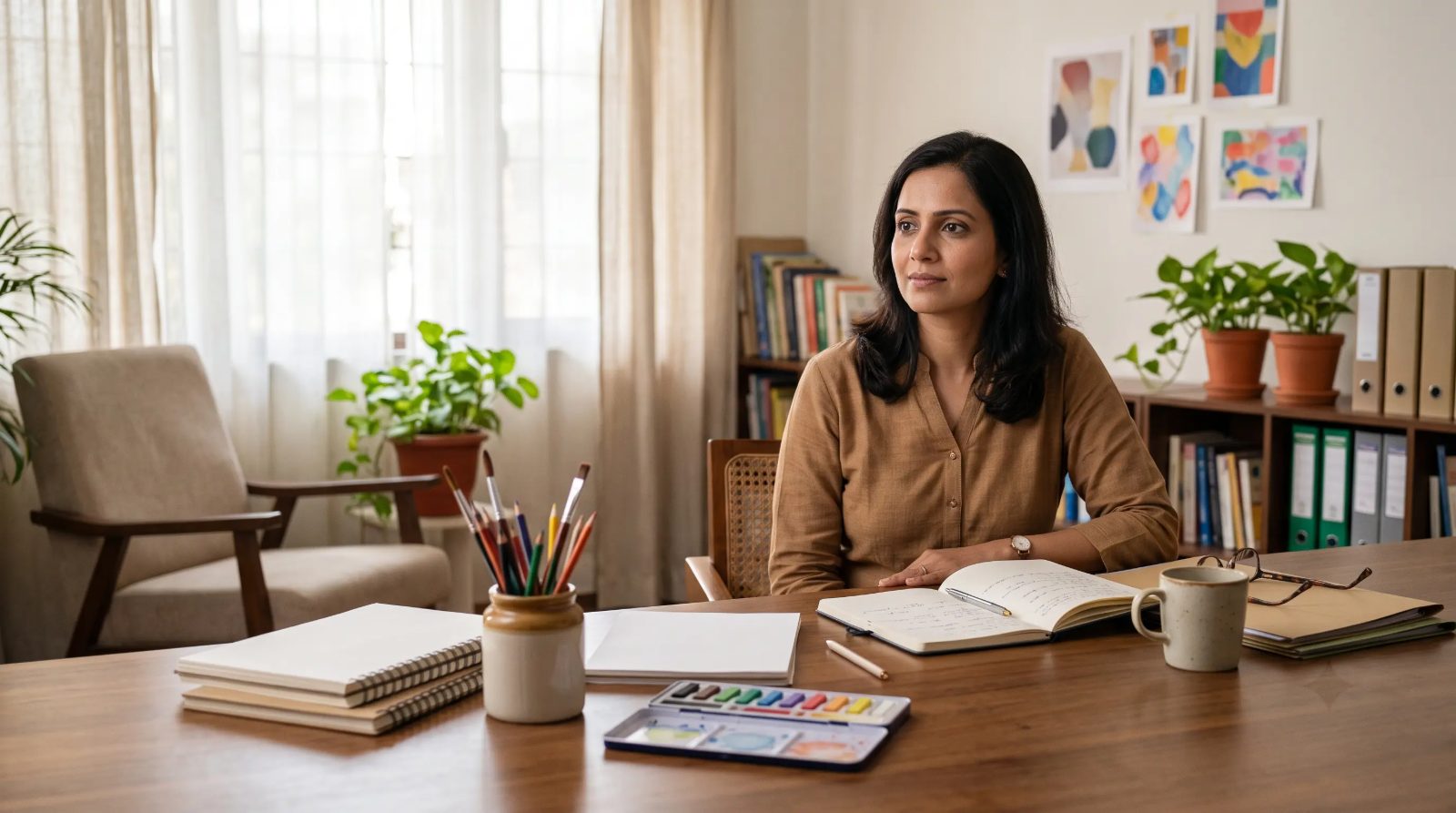
Art therapy and counselling are often discussed together because both can involve helping people explore emotions, experiences and behaviour.
They are not, however, the same method.
Counselling is commonly centred on a professional helping relationship that uses conversation, reflection and structured psychological or counselling approaches. Art therapy incorporates active art-making and creative processes within a therapeutic relationship.
The distinction matters for both clients and professionals because the methods, training and scope can differ.
This article explains the difference without treating one approach as better than the other.
This article is for general education and career planning. It is not medical advice, does not create a counselling relationship and should not be used to decide an individual's treatment without an appropriately qualified professional.
The short answer
The simplest distinction is:
Counselling primarily uses structured communication and the helping relationship.
Art therapy deliberately integrates art-making and creative processes into therapeutic work.
There can be overlap.
An art therapist may use verbal conversation alongside creative work.
A counsellor may occasionally use a drawing, worksheet or creative exercise where that falls within their competence.
But using an art activity does not automatically make a session art therapy.
Professional art therapy involves specific training in how art processes are used within therapeutic work.
The American Art Therapy Association defines art therapy as a mental-health profession involving active art-making, the creative process, applied psychological theory and human experience within a psychotherapeutic relationship.
That definition reflects the professional model used in the United States. Training and regulation differ between countries, so Indian practitioners should also check the professional framework that applies in India.
What is counselling?
Counselling is a professional helping process that generally relies heavily on communication.
Depending on the setting, a counsellor may help someone:
- explore a concern;
- understand thoughts or emotions;
- identify patterns;
- consider options;
- develop coping or problem-solving strategies;
- make decisions;
- work towards defined goals.
The exact method depends on the counsellor's training and the setting.
Counselling can take place in:
- schools;
- educational institutions;
- community organisations;
- wellbeing services;
- workplaces;
- specialised counselling services;
- other professional settings.
Counselling should not be reduced to simply giving advice.
A trained counsellor needs skills in listening, questioning, boundaries, ethics, confidentiality, documentation and referral.
What is art therapy?
Art therapy uses creative processes as an intentional part of therapeutic work.
The American Art Therapy Association describes art therapy as integrating:
- active art-making;
- creative process;
- applied psychological theory;
- human experience;
- a psychotherapeutic relationship.
In practice, art-based therapeutic work may involve materials such as:
- drawing;
- painting;
- collage;
- clay;
- mixed media;
- visual journalling;
- other structured creative processes.
The purpose is not to produce technically good artwork.
The creative process can provide another way for a person to communicate, explore or reflect.
This does not mean that every drawing contains a hidden diagnostic meaning.
Responsible practice avoids making unsupported conclusions from a person's artwork.
Art therapy vs counselling: key differences
| Area | Counselling | Art therapy |
|---|---|---|
| Main mode | Primarily verbal communication and the helping relationship | Art-making plus verbal and non-verbal exploration |
| Role of art | May be absent or supplementary | Central to the professional approach |
| Artistic skill required from client | No | No |
| Practitioner training | Counselling knowledge and skills appropriate to role | Art processes plus therapeutic and psychological foundations |
| Session structure | Often conversation-led | May move between art-making, observation, reflection and conversation |
| Interpretation | Based on professional framework and dialogue | Artwork should not be automatically or simplistically interpreted |
| Suitable settings | Schools, community, wellbeing and other counselling settings | Schools, community, wellbeing and health settings where qualifications permit |
| Scope | Depends on counsellor's qualifications and role | Depends on art-therapy training, qualifications, role and regulation |
This table describes broad differences.
Actual practice varies according to training, setting and professional framework.
How do sessions differ?
A counselling session
A counselling session may centre on conversation.
A counsellor might ask:
- What has been happening?
- How has it affected you?
- What have you already tried?
- What feels most important today?
- What would you like to change?
The professional may use reflection, summarising, questioning and other counselling methods.
An art-therapy session
An art-therapy session may include both conversation and a structured creative process.
For example, a practitioner may invite someone to work with particular art materials and then reflect on the experience.
The important point is that the art-making has a professional purpose.
It is not simply:
"Draw something and I will tell you what it means."
The American Art Therapy Association warns against inaccurate use of the term art therapy for activities or products that are not facilitated within genuine professional art-therapy practice.
Does art therapy require artistic talent?
No.
The purpose of therapeutic art-making is not to demonstrate artistic ability.
A participant does not need to know how to:
- draw realistically;
- paint professionally;
- understand colour theory;
- create visually impressive work.
A person's artwork should not be graded on artistic quality.
The focus is on the creative process and its place within the professional work.
When can art-based work be useful?
Art-based approaches can be useful when creative expression provides a meaningful way to participate in the helping process.
For some people, relying entirely on verbal conversation may feel difficult.
Creative processes can provide additional ways to:
- communicate;
- reflect;
- explore experience;
- organise thoughts;
- work with metaphor;
- engage with a structured activity.
That does not mean art therapy is automatically the best approach for every person.
The choice of approach should depend on the person's needs, preferences, professional setting and the practitioner's competence.
Is art therapy better for children?
It is too broad to say that art therapy is always better for children.
Children may engage naturally with creative activity, and art-based approaches are used in educational and therapeutic settings.
However, children differ.
One child may respond well to drawing or clay.
Another may prefer conversation, play, movement or another form of support.
Age, developmental stage, communication style, reason for referral and individual preference all matter.
The professional should choose methods based on the child rather than assuming that all children need the same approach.
Can a counsellor use art-based activities?
Potentially, yes, within appropriate competence and scope.
A counsellor may use a creative exercise as part of:
- reflection;
- psychoeducation;
- communication;
- goal setting;
- school wellbeing;
- another appropriate counselling activity.
However, there is an important distinction between:
using an art-based activity
and
representing the service as professional art therapy.
The American Art Therapy Association specifically distinguishes professional art therapy from activities offered by people who are not trained art therapists.
In India, professionals should also consider the NCAHP framework, which includes Movement Therapist, including Art, Dance and Movement Therapist or Recreational Therapist, among the professions in the Act's schedule.
A professional should describe their work accurately and avoid implying qualifications they do not hold.
Can an art therapist also use counselling skills?
Yes.
Art therapy does not eliminate verbal communication.
Art-therapy professionals need skills such as:
- listening;
- questioning;
- reflection;
- rapport building;
- ethics;
- boundaries;
- referral;
- confidentiality.
Art-making may be central to the work, but the helping relationship still matters.
This is one reason serious art-therapy education usually covers more than art materials.
Professional preparation needs to address the psychological and interpersonal aspects of working with people.
How training and scope differ
Training should match the method being used.
Counselling training may include
- counselling theories;
- communication;
- ethics;
- boundaries;
- development;
- helping skills;
- documentation;
- referral;
- supervised experience.
Art-therapy training may additionally include
- art materials and creative processes;
- art-therapy theory;
- ethical handling of artwork;
- art-based facilitation;
- visual and symbolic expression;
- reflective creative practice;
- integration of art and psychological theory.
A short introduction to creative activities should not be treated as equivalent to comprehensive professional art-therapy preparation.
Likewise, completing an art-therapy course does not automatically provide every competency associated with general counselling or clinical psychology.
What does the Indian regulatory context mean?
India's regulatory context is developing and should be checked carefully.
The National Commission for Allied and Healthcare Professions Act, 2021 lists Movement Therapist (including Art, Dance and Movement Therapist or Recreational Therapist) among the allied and healthcare professions covered by the Act.
The official Allied and Healthcare Professionals portal currently lists Movement Therapist among the professions recognised under the Act.
The same portal also states that its current enrolment database is for data collection and is not registration, and that the registration process will begin according to the applicable regulatory implementation.
That distinction is important.
A person should not describe enrolment in a database, a private course or a private certification as statutory professional registration.
What about counselling?
The NCAHP schedule also includes several counselling-related categories, including Integrated Behaviour Health Counsellor and Health Educator and Counsellors, alongside Psychologist, except Clinical Psychologist covered under the RCI framework for persons with disabilities.
The exact professional category, qualification requirement and applicable registration route therefore matter.
Do not assume that every role using the word counsellor has identical statutory requirements.
What about Clinical Psychology?
Clinical Psychology remains a separate pathway under the Rehabilitation Council of India framework.
RCI's Section 19 list includes Clinical Psychologists among the professionals registered in the Central Rehabilitation Register when recognised qualification requirements are met.
Neither a general counselling certificate nor an art-therapy certificate should be presented as making someone an RCI-registered Clinical Psychologist.
Professional scope depends on the practitioner's complete education, competence, role and applicable regulatory framework. A private certification does not replace statutory registration or a regulated qualification where one is required.
Which approach should a professional study?
Start with the work you want to perform.
Consider counselling-focused training if you want to develop
- professional listening;
- structured helping conversations;
- counselling communication;
- goal-focused work;
- referral and boundaries;
- verbal reflection.
Consider art-therapy-focused training if you want to develop
- therapeutic use of creative processes;
- art-based facilitation;
- understanding of art materials;
- creative reflection;
- ethical handling of artwork;
- integration of art with helping practice.
Consider both carefully if your role may use both
Some professionals may eventually develop competence in both areas.
That does not mean one weekend workshop in each creates two professional qualifications.
Build skills deliberately and ensure the way you describe your work matches your actual preparation.
Common misunderstandings
"Art therapy is just counselling with drawing"
No.
Professional art therapy treats creative process as an intentional part of the work and requires relevant specialist preparation.
"Counselling is just talking"
No.
Counselling involves structured professional skills, ethics, boundaries, judgement and referral.
"The therapist can diagnose someone by looking at their drawing"
Not automatically.
A person's artwork should not be simplistically treated as a diagnostic test.
"You have to be artistic for art therapy"
No.
The client's artistic ability is not the point of the process.
"A counsellor can call any drawing activity art therapy"
That wording can be misleading.
Professionals should distinguish between using an art-based activity and providing professional art therapy.
How to choose between the two as a career
Ask yourself:
- Do I prefer primarily verbal helping work?
- Am I genuinely interested in visual and creative processes?
- Do I want art-making to be central to my professional method?
- What population do I want to work with?
- What setting do I want to work in?
- What academic foundation do I already have?
- What additional training do I need?
- Does the role fall within a statutory professional framework?
- What supervision or practical experience can I access?
- How will I accurately describe my professional scope?
The answer may not be one or the other forever.
Career development can involve building complementary skills over time.
Frequently asked questions
What is the main difference between art therapy and counselling?
Counselling commonly relies primarily on structured communication and the helping relationship, while art therapy deliberately integrates art-making and creative processes into therapeutic work. Both can involve conversation, reflection and professional boundaries.
Is art therapy a type of counselling?
Art therapy and counselling overlap in some helping skills, but they should not be treated as identical professional methods. Art therapy has a specific emphasis on creative process and art-making within therapeutic work.
Is art therapy better than counselling?
No approach is universally better. The appropriate method depends on the person's needs, preferences, setting and the qualifications of the professional providing the service.
Can a counsellor use drawing or art activities?
Yes, a counsellor may use appropriate creative activities within their competence and professional role. That does not automatically mean the service should be described as professional art therapy.
Do you need to be good at art for art therapy?
No. Art therapy is not based on producing technically impressive artwork, and participants do not need professional artistic skills.
Is an art therapist the same as a Clinical Psychologist?
No. Art therapy and Clinical Psychology are separate professional pathways. RCI separately registers Clinical Psychologists who meet its recognised qualification requirements.
Where formal training fits
Professionals who want art-making to become a deliberate part of their helping work should study more than a collection of creative exercises.
The Certified Art Therapist programme provides assessed professional education in art-based therapeutic approaches for professional upskilling. Check current pricing and programme details on the programme page.
Therapy Council is an independent private certification body. Therapy Council credentials are permanently verifiable through the public Credential Register.
Therapy Council certification is not NCAHP or RCI registration, a licence to practise, or a protected professional title. It does not replace a degree or regulated qualification and does not by itself authorise diagnosis, clinical treatment or practice beyond the learner's existing competence and applicable professional framework.
Sources
- Ministry of Health and Family Welfare, Government of India, National Commission for Allied and Healthcare Professions Act, 2021
- Ministry of Health and Family Welfare, Government of India, Allied and Healthcare Professionals Enrolment Portal FAQs
- Ministry of Health and Family Welfare, Government of India, Allied and Healthcare Professionals Enrolment Portal
- Rehabilitation Council of India, Categories of Professionals under Section 19
- American Art Therapy Association, What is Art Therapy?
- American Art Therapy Association, About Art Therapy