
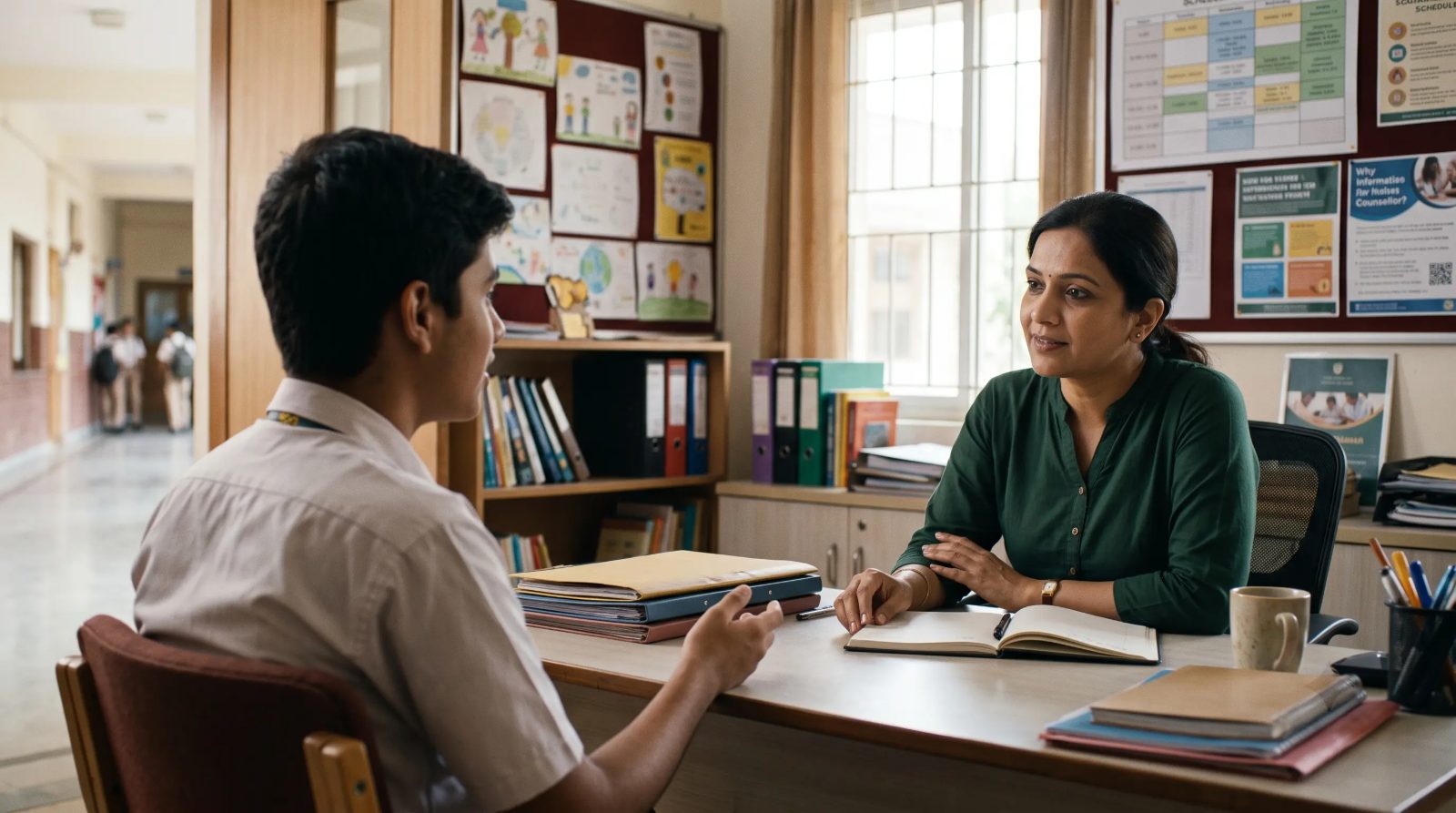
Being approachable is useful for a school counsellor, but approachability alone is not professional competence.
School counselling requires a combination of communication, observation, ethical judgement, documentation, safeguarding, referral and the ability to work with students, parents, teachers and school leaders. A counsellor also needs to understand the educational environment rather than treating the school as if it were a private therapy clinic.
In India, this is particularly relevant because CBSE updated its requirements for counselling and wellness roles in January 2026. The amended Affiliation Bye-Laws now identify specific competencies expected of the Counseling & Wellness Teacher (Socio-Emotional Counselor).
This guide looks at the practical skills behind those expectations and what they mean in everyday school work.
This article is for general professional education. It is not medical advice, does not create a counselling relationship and should not be used as a substitute for a school's safeguarding or emergency procedures.
What does CBSE expect from a school counsellor in 2026?
CBSE Circular No. 02/2026 amended Clause 2.4.12 of the Affiliation Bye-Laws.
For the Counseling & Wellness Teacher (Socio-Emotional Counselor), CBSE states that the appointed person should possess competencies in:
- Social and Emotional Learning delivery;
- crisis intervention;
- identification of mental-health concerns;
- parent and teacher sensitisation;
- confidentiality.
The circular also states that the appointed person must undergo 50 hours of capacity-building programmes preferred by the Board for psycho-social counselling.
CBSE additionally requires one socio-emotional counsellor for up to every 500 students enrolled in a CBSE-affiliated school.
A separate February 2026 CBSE circular on mental health and Social Emotional Learning emphasises school capacity to recognise warning signs, respond appropriately, use referral mechanisms and communicate with students in a sensitive, inclusive and non-discriminatory manner.
These requirements provide a useful starting point, but they do not capture every practical skill a counsellor uses during a working day.
Skill 1: Listening without taking over the conversation
Listening is one of the most basic counselling skills, but professional listening is different from simply being friendly.
A school counsellor needs to listen closely enough to understand:
- what the student is saying;
- what the student may be struggling to explain;
- what has changed;
- what context matters;
- whether the concern falls within the counsellor's role;
- whether another person or professional needs to become involved.
Useful listening behaviours can include:
- allowing the student time to speak;
- reflecting important points;
- checking understanding;
- summarising accurately;
- avoiding unnecessary interruption;
- staying non-judgemental.
A CBSE mental-health manual for schools identifies basic counselling skills including empathy, reflection, paraphrasing, focusing, non-judgement and building connection.
The aim is not to make the student dependent on the counsellor.
The aim is to understand the concern well enough to respond responsibly.
Skill 2: Asking useful questions
Counsellors need to know how to ask questions without turning a conversation into an interrogation.
Open questions can help a student explain a situation in their own words.
Focused questions can help clarify:
- what happened;
- when it started;
- who is involved;
- how the situation is affecting school life;
- what support the student already has;
- what needs to happen next.
Good questioning also means knowing when not to keep asking questions.
A student may need time, a different communication approach or referral to someone with a different professional role.
The counsellor's job is not to extract every detail.
It is to gather enough appropriate information to understand the situation and decide what support or referral is needed.
Skill 3: Building trust while keeping boundaries
Students need to feel that the counselling space is respectful and safe enough for them to speak.
But trust does not mean promising absolute secrecy.
A counsellor should explain confidentiality and its limits in language appropriate to the student's age and understanding.
There may be circumstances in which information needs to be shared according to safeguarding requirements, school procedures or other professional responsibilities.
This is why boundary-setting should happen early.
Students should understand:
- what the counsellor's role is;
- what confidentiality generally means;
- when information may need to be shared;
- who may become involved if further support is necessary.
Trust grows when expectations are clear and consistently followed.
Skill 4: Recognising when a student needs more support
A school counsellor needs to distinguish between concerns that can be supported within the school role and concerns that require additional assessment or specialist support.
CBSE's 2026 amendment explicitly identifies identification of mental-health concerns as a competency for the socio-emotional counsellor role.
This does not mean diagnosing students.
Recognition means noticing that something may require further attention and deciding on an appropriate next step.
A counsellor may need to consider referral when:
- the concern is outside their training or competence;
- specialist assessment is required;
- the student's functioning has changed substantially;
- the situation requires a service the school cannot provide;
- immediate safety support is needed.
Referral is part of competent counselling practice.
It is not evidence that the counsellor has failed.
Read When Should a School Counsellor Refer a Student? for a more detailed discussion of referral decisions.
Skill 5: Safeguarding and crisis response
School counsellors work with children and adolescents, which makes safeguarding knowledge essential.
CBSE's 2026 amendment specifically includes crisis intervention among the required competencies for the socio-emotional counsellor role.
A counsellor should understand the school's procedures for:
- escalating immediate safety concerns;
- informing the appropriate safeguarding lead or school authority;
- contacting parents or guardians when appropriate;
- arranging referral to qualified clinical or emergency support;
- recording actions taken;
- protecting confidentiality while sharing information that genuinely needs to be shared.
A crisis is not the time to improvise a personal system.
Counsellors should know the school's protocol before an urgent situation occurs.
If a student appears to be in immediate danger or experiencing an acute mental-health crisis, follow the school's emergency and safeguarding procedure and involve an appropriately qualified clinical professional or emergency service. In India, Tele-MANAS can be reached at 14416 for round-the-clock mental-health support.
Skill 6: Documenting counselling work properly
Documentation is one of the least glamorous but most important school counselling skills.
Useful notes should be:
- factual;
- proportionate;
- relevant;
- clear;
- professionally worded;
- stored according to the school's confidentiality and data-handling procedures.
A counselling note is not a personal diary.
Avoid writing unnecessary assumptions about a student's motives or personality.
Where appropriate, documentation may include:
- reason for contact;
- relevant observations;
- information provided by the student;
- actions taken;
- referrals made;
- agreed follow-up.
CBSE's February 2026 mental-health circular also requires schools to maintain anonymous records and prepare an annual report covering wellness interventions, student referrals, training sessions and mental-health-related activities.
For more detail, read School Counsellor Documentation: What to Record, What to Avoid, and How to Write Better Notes.
Skill 7: Working with parents and teachers
School counsellors rarely work with students in complete isolation.
Teachers may be the first people to notice:
- changes in attendance;
- withdrawal;
- conflict;
- classroom difficulties;
- changes in participation;
- academic deterioration.
Parents and guardians also hold information about the student's life outside school.
A skilled counsellor needs to communicate with adults without turning the student into a topic of gossip or sharing more confidential information than necessary.
This involves:
- explaining concerns clearly;
- separating observation from interpretation;
- listening to different perspectives;
- managing emotionally difficult conversations;
- keeping the student's wellbeing central;
- sharing only information that is appropriate to share.
CBSE's January 2026 amendment specifically names parent and teacher sensitisation among the competencies expected of socio-emotional counsellors.
The February 2026 CBSE circular also directs schools to organise sensitisation programmes for parents and guardians on student mental health.
Skill 8: Social and Emotional Learning
School counselling is not only reactive.
Counsellors can also contribute to preventive and developmental work.
CBSE's 2026 requirements specifically identify Social and Emotional Learning (SEL) delivery as a competency for the Counseling & Wellness Teacher.
SEL-related work can support areas such as:
- emotional awareness;
- communication;
- relationship skills;
- responsible decision making;
- coping and self-management;
- help-seeking.
The counsellor's role may include supporting school-wide activities, student sessions and collaboration with teachers.
CBSE's February 2026 circular also asks schools to integrate mental-health literacy, emotional regulation, life-skills education and awareness of support services into student orientation and curricular activities.
This means a school counsellor needs to be able to think beyond individual sessions.
Skill 9: Cultural and developmental awareness
The same conversation cannot be used with every student.
A six-year-old, a thirteen-year-old and a seventeen-year-old differ in:
- language;
- emotional development;
- independence;
- family involvement;
- understanding of confidentiality;
- ability to describe internal experiences.
Counsellors therefore need developmentally appropriate communication.
They also need cultural awareness.
A student's experience may be shaped by:
- family expectations;
- language;
- disability;
- social and economic context;
- gender expectations;
- religion or community;
- academic environment;
- access to outside support.
Cultural awareness does not mean assuming that everyone from a particular background will think or behave in the same way.
It means remaining curious about the individual student's context rather than imposing your own assumptions.
Skill 10: Professional judgement
Many school counselling situations do not have a perfect scripted response.
Professional judgement is the ability to combine:
- what you know;
- what you have observed;
- the limits of your role;
- school policy;
- ethical principles;
- safeguarding requirements;
- available referral options.
For example, a counsellor may need to decide:
- whether a concern can be handled through routine school support;
- whether a parent or teacher needs to be involved;
- whether information can remain confidential;
- whether referral is required;
- how urgently the next step needs to happen.
Judgement improves through education, supervision, reflection and experience.
Confidence without judgement can create risk.
Good judgement often means slowing down, checking the facts and seeking appropriate support.
Technical skills and soft skills are both necessary
School counselling requires both interpersonal and professional skills.
| Interpersonal skills | Professional skills |
|---|---|
| Listening | Documentation |
| Empathy | Safeguarding |
| Rapport building | Referral |
| Clear communication | Confidentiality |
| Patience | Scope awareness |
| Non-judgement | Case decision making |
| Collaboration | School procedures |
| Age-appropriate communication | SEL planning |
Calling the first group soft skills can make them sound optional.
They are not.
But interpersonal ability also cannot substitute for professional knowledge.
A warm counsellor who does not understand confidentiality, referral or safeguarding is not adequately prepared for the role.
What skills should a new school counsellor develop first?
If you are at the beginning of your career, prioritise foundations.
A useful sequence is:
- learn the scope of the school counsellor role;
- develop listening and questioning skills;
- understand confidentiality and its limits;
- learn safeguarding and referral procedures;
- practise factual documentation;
- understand child and adolescent development;
- learn how to communicate with parents and teachers;
- develop SEL knowledge;
- practise with feedback and supervision;
- continue building judgement through real educational settings.
You do not need to become an expert in every possible student concern before beginning your career.
You do need to know your limits.
What should a school counsellor not do?
Competence includes knowing where the role ends.
A school counsellor should not assume that the title allows them to:
- diagnose every mental-health condition;
- provide specialist treatment outside their qualifications;
- promise absolute confidentiality;
- manage serious concerns without appropriate escalation;
- keep no professional records;
- work without regard to school safeguarding procedures;
- describe a private certification as a statutory licence.
The correct scope depends on the counsellor's qualifications, competence, employment role and applicable professional framework.
School counselling training can prepare professionals for educational and student-wellbeing work within their competence. It does not by itself authorise diagnosis, clinical treatment or use of a regulated professional title.
Frequently asked questions
What are the most important skills for a school counsellor?
The most important skills include professional listening, questioning, rapport building, confidentiality, documentation, safeguarding, referral, collaboration with parents and teachers, SEL delivery and professional judgement. CBSE's 2026 requirements specifically identify SEL, crisis intervention, identification of mental-health concerns, parent and teacher sensitisation and confidentiality.
Does a school counsellor need good communication skills?
Yes. School counsellors communicate with students, parents, teachers, school leaders and external professionals. Communication needs to be clear, age-appropriate, sensitive and consistent with confidentiality requirements.
Does a school counsellor need to know how to diagnose mental-health conditions?
No. Recognising that a student may need additional mental-health support is different from making a clinical diagnosis. Counsellors should work within their qualifications and refer when specialist assessment is required.
Is documentation an important school counselling skill?
Yes. Clear and proportionate documentation helps record relevant information, actions, referrals and follow-up. Notes should remain factual and be handled according to the school's confidentiality and data procedures.
What does CBSE require school counsellors to know?
CBSE's January 2026 amendment lists competencies including SEL delivery, crisis intervention, identification of mental-health concerns, parent and teacher sensitisation and confidentiality for the socio-emotional counsellor role. It also specifies capacity-building requirements for appointed counsellors.
Can empathy alone make someone a good school counsellor?
No. Empathy is important, but school counselling also requires professional knowledge, boundaries, safeguarding, documentation, referral and sound judgement.
Where formal training fits
Many school counselling skills can be understood in theory, but applied competence develops through structured learning, practice, feedback and appropriate experience.
The Certified School Counsellor programme provides assessed professional education focused on school counselling practice, including the professional skills and boundaries relevant to educational settings. Check current pricing and programme details on the programme page.
Therapy Council is an independent private certification body providing assessed professional education for professional upskilling. Therapy Council credentials are permanently verifiable through the public Credential Register.
Therapy Council certification is not a licence, statutory registration or protected professional title. It does not replace a degree or regulated qualification, and it does not authorise a person to diagnose or treat mental-health conditions.
Sources
- Central Board of Secondary Education, Circular No. 02/2026: Amendment in Clause 2.4.12 regarding counsellors in CBSE schools
- Central Board of Secondary Education, Promoting Mental Health and Wellness and Social Emotional Learning in Schools, Circular TRG-03/2026
- Central Board of Secondary Education, Counseling Hub and Spoke School Model
- Ministry of Education, Government of India, CBSE Mental Health and Wellbeing Manual